
In today’s connected business environment, it’s crucial to safeguard your network from threats originating on the open internet. A network vulnerability assessment is the process of identifying threats, uncovering current vulnerabilities, and producing actionable data to strengthen your company’s network, working alongside the broader set of network security tools your organization already relies on. In short, it’s a technique for identifying and quantifying threats across every device connected to the network. This guide covers why, when, and how to run one.
What do network vulnerability assessments look for?
In an attempt to enhance network security, network vulnerability assessments look for risks and weaknesses in applications and network infrastructure. These specialized tools look into things like unpatched operating systems and software, open ports and services, unprotected wireless networks, incorrect web or network application configurations, network architecture flaws, security policy compliance, mobile device vulnerabilities, access control and permissions, physical security issues, exposed Internet of Things (IoT) devices, weak passwords, and application-level vulnerabilities:
- Unpatched software and operating systems:
Such are among the key causes of network insecurity. These vulnerabilities allow the hacker to perform a hacker’s attack and reach out to thereby acquiring private info. - Open ports and services:
Since attackers can freely use the open ports, they can bypass all the security mechanisms installed and directly access the network systems. Such investigation reveals potential access points for the accessing intruder, whether in the form of open ports or services. - Unsecured wireless networks:
Open wireless networks are always common routes through which the attackers or unauthorized persons launch an attack or unauthorized access to other people’s information. - Misconfigurations in networks or web applications:
One having a wrong installation of a network or failure in web applications could create openings that hackers would exploit. Two examples of the misconfiguration are unsafe SSL/TLS configurations and improper firewall configuration. Left unchecked, these issues are also a common cause of the kind of slowdowns covered in our guide on how to identify a bottleneck in your network. - The network architecture’s shortcomings include:
I learned that apart from the identification of specific vulnerabilities, meaningful insights into potential complicated failure modes or insufficient segmentation or isolation to prevent lateral movement may only be achievable, if at all, when assessing the overall network architecture and distributed network design.
- Observance of security regulations:
This means that your business can also be at risk of data loss, hacking, and legal consequences whenever you breach these security allegations. Vulnerability assessments reduce these risks by considering the degree of conformity with security policies. - Access control and permissions:
Supervisory checks of who is accessing or seeking access to programs or data are essential to ensure that only special users or special systems get access to those special programs or data. - Security policy compliance:
Ensuring that the physical connectivity of the equipment on the network is secure is the best way of avoiding cases of tampering or unlawful entry into the network which is very dangerous to the network. - Vulnerable mobile devices:
Possible weaknesses in mobile devices include, outdated operating systems, badly permitted applications, users and their behavior, and risky settings is what is being looked for by a comprehensive assessment of network vulnerability. - Exposed IoT devices:
Weak IoT devices are known to have a severe impact on a company’s security and privacy situation in the most traumatic manner. They could be in danger from many types of attacks like ransomware, malware, SQL injection, wardriving, denial of service (DoS), and zero-day attacks. This risk is especially high in connected environments — see our breakdown of healthcare network monitoring and the strategies healthcare IT teams rely on to keep exposed devices in check.
- Weak passwords:
This is followed by poor pass wording as a major contributing factor towards network vulnerabilities. Brute force attacks enable the hackers to guess the pathetic passwords and get hold of private data. - Application-level weaknesses:
Application level vulnerabilities can allow hackers to read, write, delete private data, execute a virus or Trojan program, bypass the authorization or authentication controls or perform a denial of service attack. Application level attacks entail the following; buffer overflow attacks, cross site scripting and SQL injection flaw.
Essential steps for conducting vulnerability assessments
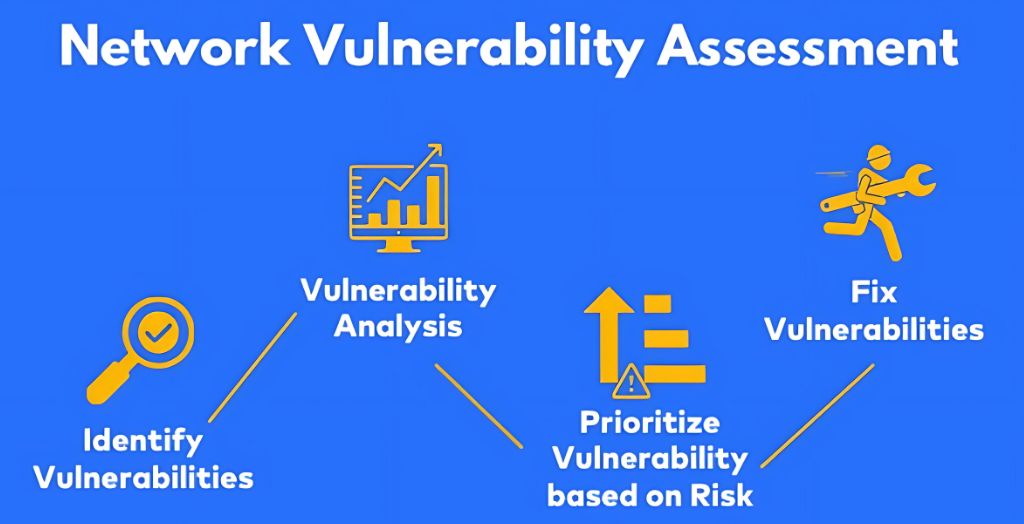
Planning and designing, asset discovery, configuration, network scanning, result analysis, vulnerability prioritization, and report creation are the six crucial processes in the vulnerability assessment process.
- Organizing and creating
Deciding on the precise components and boundaries of the evaluation is the initial step towards the beginning of a network vulnerability assessment. This consists of hardware, user devices, apps and also network infrastructures. After the scope, for each asset specify its security capacities, level of risk, user authorization, settings, configurations and other parameters. Finally, complete any outstanding planning and organizing, equip oneself with all the necessary items that may be needed; organize the test area. - Asset Discovery
The next thing is to choose what should be scanned. Other examples include the allowed use of consortium through corporate owned, personally enabled (COPE) and Bring Your Own Device (BYOD) mobile devices and Internet of Things devices. Secondly, identify the rationale based on which the hardware, apps, devices, and the network element would be assessed. The following ones must be established for these assets: security capabilities, risk tolerance, user permissions, configurations, and others.
- Scanning the network
Scanning is more or less the process of seeking vulnerabilities in your network. A Vulnerability scanner is used in a network to determine possible security risks that are present in a network.
- Analysis of the results
You must examine any issues that are raised after scanning in order to identify any potential weaknesses.
- Prioritizing vulnerabilities
Subsequently in this second process, you can re-sort these new vulnerabilities based on the threat level they represent.
- The creation of reports
Finally, produce an extensive report summarizing the findings of the assessment. Other recommendations that may be taken should also be included in the report as well as a recommendation for further evaluations.
Benefits of network vulnerability assessment for your organization
Regular network vulnerability evaluations can help your company reduce risks, save money, manage patches more effectively, allocate resources more efficiently, and improve continuously.
- Reduction of risks
You then get to know areas that could be exploited and get to minimize exposure mostly reducing the chances of being attacked. By adopting this strategy, you help stop the threats from occurring since you deal with potential problems to computer security before these threats can bend and twist them to their advantage. - Savings
With vulnerability assessments performed to mitigate the risk of data breaches, outages, and other cyber disasters, you might save your company a good deal of money to not have to pay for response, recovery, and legal services. - Improved patch administration
Through such assessments, a business can easily address known areas of weakness such as outdated software and configurations that require patching or updating. Addressing known threats as soon as possible, alongside tracking network performance and its key metrics, keeps you working in a safer, faster environment.
- Resource allocation that is optimized
When you carry out vulnerability assessments you are able to know the best way to use your security resources. It enhances security as it posts the probability of resource and time being allocated to the most vulnerable sectors. - Constant enhancement
Assessments of network vulnerabilities are continuous procedures rather than one-time events. Assessments provide a consistent development of cybersecurity enhancement that extend their operations to accommodate new threats and discoveries made in technology.
The Difference Between Vulnerability Scanning and Vulnerability Assessment

Vulnerability scanning has the ability to identify potential weaknesses in operating software and systems. The impact and criticality of the vulnerability, along with strategies for leveraging it, are not stated.
A vulnerability assessment is a more thorough process that searches for, categorizes, and ranks vulnerabilities, offering detail on impact, severity, and potential for exploitation. It’s similar to how understanding the 4 types of network taps gives you deeper, ongoing visibility compared to a one-time snapshot.
An essential component of vulnerability assessment is vulnerability scanning. On its own, though, it is insufficient. Manual analysis is also necessary for vulnerability assessment in order to find and rank vulnerabilities.
Conclusion
You can stay one step ahead of attackers and resolve security issues before they become major incidents by evaluating your network for vulnerabilities and acting on what you find. But a point-in-time assessment only tells you what’s wrong today. It won’t catch what breaks tomorrow.
That gap is what continuous network monitoring is for: catching new vulnerabilities, misconfigurations, and failures as they happen, instead of waiting for the next scheduled scan.
Ready to pair periodic assessments with real-time visibility? Splitpoint Solutions provides managed monitoring built to catch what assessments only find after the fact. Get in touch with our team for a free consultation.