
Data Center Network Monitoring Services
Managed data center network monitoring from Splitpoint shows traffic across your fabric, workloads, sites, and application paths. It helps your team spot slowdowns, failures, and performance issues early and act faster.
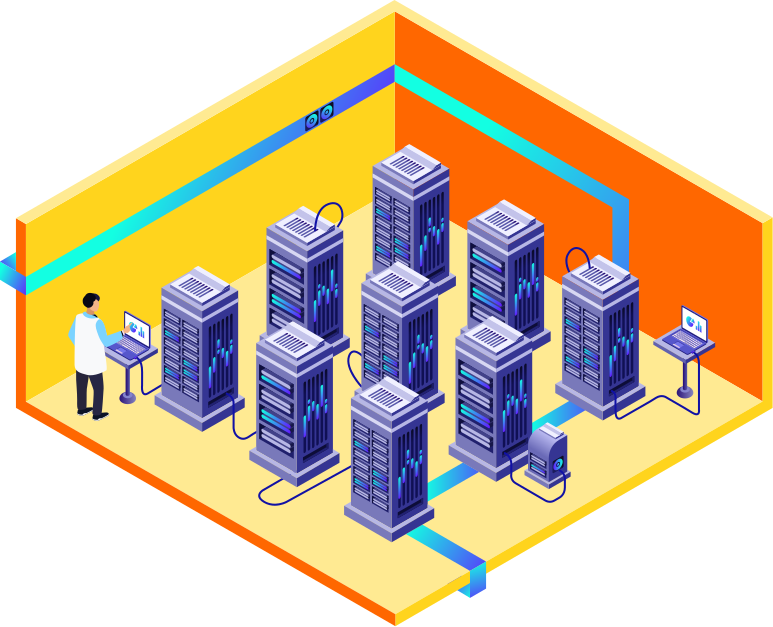
What We Monitor Inside the Data Centre
Four layers, one timeline. Each is polled, collected or measured natively — there is no second tool for the overlay and no third for the interconnect.

Fabric and Switch Health
Leaf-spine switching, top-of-rack, uplinks and interconnects polled continuously with interface errors, discards and buffer drops surfaced before they become packet loss a user can feel.

East-West Traffic
Most data centre traffic never leaves the building. Flow analysis shows which workloads talk to which, and how much, so a noisy neighbour is a name rather than a theory.

Application Path Tracing
The route a transaction takes from load balancer through fabric to storage, measured hop by hop — so a slow application is attributed to a segment instead of argued about between teams.

Interconnects and Cloud On-Ramps
Latency, loss and utilisation across every data centre interconnect, replication link and cloud on-ramp, with network latency monitoring for continuous link tracking.
How Does Data Center Network Monitoring Improve Reliability
Reliable data center operations need continuous monitoring to run smoothly. Splitpoint Solutions uses data center infrastructure monitoring with MIVU to detect issues early, reduce downtime, and ensure system reliability.
One-Second Granularity Where It Matters
Capture traffic every second with data center monitoring software to spot brief performance issues early.
Error Counters, Not Just Up or Down
Track errors and dropped traffic with equipment monitoring before they develop into larger network problems.
Root Cause, Not Just an Alert
Identify root causes faster through data center monitoring services and resolve network issues before they escalate.
Physical, Virtual and Cloud on One Timeline
Gain clear visibility across physical, virtual, and cloud systems with infrastructure monitoring.

Key Features of Data Center Network Monitoring
MIVU provides clear visibility into data center operations, helping IT teams monitor network performance, detect issues early, track changes, and maintain reliable infrastructure as their environment grows.

Capacity Trending by Port and Uplink
Use a data center monitoring system to track bandwidth, spot busy ports, and plan capacity.

Baseline-Driven Alerting
Remote infrastructure monitoring compares activity with normal patterns to spot unusual events.

Configuration Change Tracking
Network infrastructure monitoring tracks configuration changes across devices to spot unexpected changes.

Scales by Collector, Not by Licence
Data center monitoring services scale across devices and locations as your environment grows.
Why Choose Us
See why leading enterprises are switching to Splitpoint Solutions.
| Feature | Splitpoint | Traditional Tools |
|---|---|---|
| Rack / device-level visibility | ✓ | Partial |
| Real-time monitoring | ✓ | Limited |
| AI-powered alerts | ✓ | ✕ |
| Capacity & performance trending | ✓ | Partial |
| Predictive analytics | ✓ | ✕ |
| 24/7 expert support | ✓ | Varies |
| Setup time | Minutes | Days–weeks |
Trusted by leading companies across industries






Why teams
choose
Splitpoint
Built to give your team complete visibility and control over the systems that matter.

See everything in one place
Eliminate blind spots. Monitor network, infrastructure and applications together, instead of stitching together separate tools.

Find the root cause faster
Move from guessing to knowing. Trace an issue across the stack and fix it before it reaches your users.

Built for enterprise scale
Designed to handle high-volume environments without slowing down or losing detail.

Your data, your control
Analyse, troubleshoot and report on your own terms, with full access to the underlying data.
All Articles
Network Monitoring for Schools: Security and Uptime
Network monitoring has become essential for schools, colleges, and universities, which run on...

Network Monitoring Challenges Faced by Schools and Colleges
Running a campus network today looks nothing like it did even five years ago. Between online...

Key Types of Network Monitoring Used in the Education Industry
A district can run three monitoring tools and still not know why a state assessment stalled in the...

Top 11 Network Monitoring Tools for the Education Industry
A district network can pass every uptime check on the dashboard and still be failing. Ninth period...

Hybrid Infrastructure: The Enterprise Blueprint for Modern IT Operations
Enterprise IT no longer runs from a single location. Most organizations today operate distributed...
Top 5 Features to Look for in Data Center Network Monitoring Tools
Data center network monitoring tools are software platforms that continuously track the health,...
Frequently Asked Questions
Everything you need to know before getting started with Splitpoint Solutions.
What should be monitored in a data center network?
A data center network should be monitored for bandwidth usage, latency, packet loss, interface errors, device availability, CPU and memory usage, port utilization, traffic patterns, and hardware health. Monitoring switches, routers, firewalls, links, servers, and virtual infrastructure together gives IT teams a clearer view of overall network performance.
How does data center network monitoring help prevent downtime?
Splitpoint Solutions helps prevent downtime by monitoring network performance in real time, detecting issues like congestion, packet loss, and device failures early so IT teams can respond before they cause major disruptions.
How can data center network monitoring help identify the root cause of an issue?
Monitoring collects performance data from network devices, infrastructure, and applications so teams can trace where a problem begins. Instead of investigating each system separately, MIVU brings related monitoring data together, helping teams determine whether an issue originates from the network, server infrastructure, application layer, or another dependency.
Can data center network monitoring detect bandwidth bottlenecks?
Yes. Data center network monitoring tracks bandwidth utilization, traffic flows, interface performance, packet loss, and congestion across network links. This helps teams identify overloaded switches, uplinks, or network paths and address capacity problems before they begin affecting application performance.
Can data center network monitoring cover both on-premises and cloud environments?
Yes. Modern data centers often operate across physical infrastructure, virtual systems, private clouds, and public cloud platforms. MIVU provides unified visibility across cloud and on-premises environments, helping IT teams monitor distributed infrastructure without relying on separate monitoring dashboards.
How does MIVU support data center network monitoring?
Splitpoint Solutions’ MIVU provides centralized monitoring across networks, infrastructure, applications, and user experience. It collects real-time performance data and brings related signals into one environment, helping IT teams identify performance issues, reduce monitoring blind spots, investigate root causes, and manage complex data center environments more effectively.