
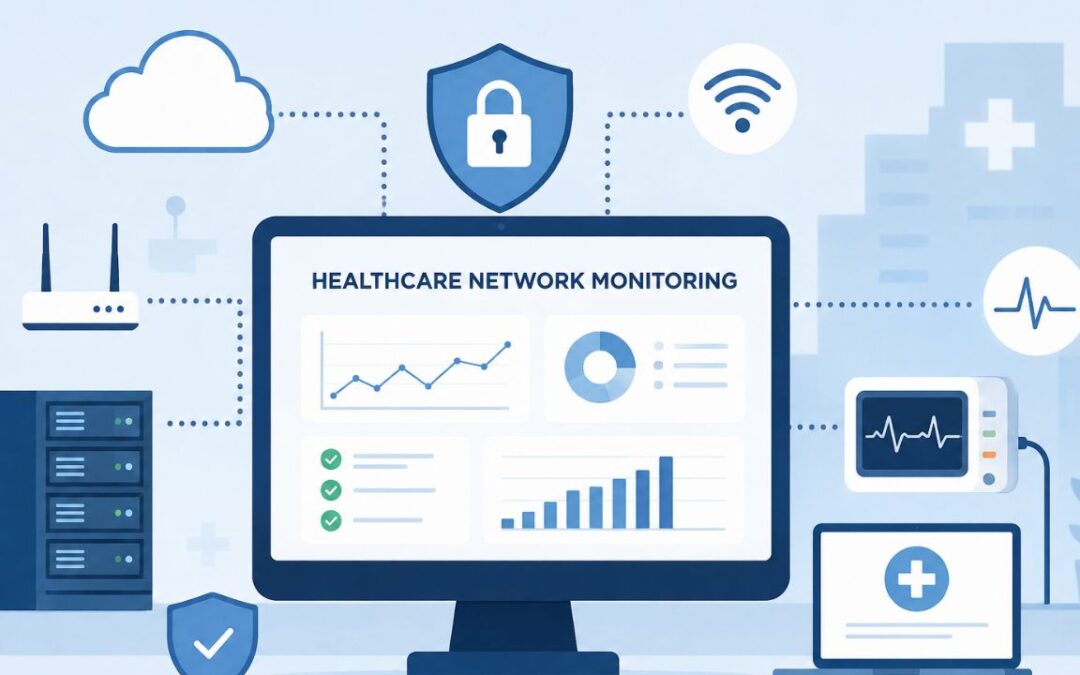
Healthcare network monitoring is unlike monitoring in any other sector. Healthcare networks carry patient records, power life-saving devices, support telehealth calls, and keep administrative systems running — all at the same time. When the network slows down or goes offline, the consequences go far beyond an inconvenient IT ticket. Patient care suffers, data becomes inaccessible, and compliance risks rise quickly.
That is why effective healthcare network monitoring is not just an IT priority — it is a patient safety priority. This guide walks through the best strategies for healthcare network monitoring, written for IT teams, administrators, and anyone responsible for keeping a healthcare environment connected and reliable.
Why Healthcare Network Monitoring Needs Its Own Approach
Most industries need good network monitoring. Healthcare needs great network monitoring — and for very specific reasons.
First, the devices connected to a healthcare network are incredibly diverse. From imaging machines and infusion pumps to nurses’ workstations and patient portals, every device has different traffic needs — and the rise of IoMT (Internet of Medical Things) devices has made this mix even harder to manage. Second, compliance standards like HIPAA require that patient data is protected and that audit trails are maintained. Third, downtime in a hospital or clinic does not just mean lost productivity — it can mean delayed diagnoses and interrupted treatments.
A general-purpose approach to network performance management strategy will not cut it here. Healthcare demands monitoring that is continuous, proactive, and built around the unique flow of clinical and administrative data.
1. Build a Complete Picture of Your Network First
You cannot monitor what you do not know exists. The first step in any solid healthcare network monitoring strategy is full visibility — knowing every device, every connection, and every segment of your network.
Many healthcare organizations have grown over time through mergers, new facilities, or added services. This often means layers of older and newer infrastructure running side by side. Legacy systems may not be documented well. IoMT devices may have been added without a formal process.
Start by running a thorough discovery of your network. Map out every endpoint, every switch, every connection point, and every vendor access path. Tools that provide automatic discovery can help, especially in large hospital environments where manual tracking is not realistic.
Once you have a clear map, you can set up monitoring rules that actually reflect your environment — not a generic template. Learn more about the core metrics behind network performance and how to apply them in complex setups.
2. Move from Reactive to Proactive Monitoring
Many healthcare IT teams still operate in a reactive mode: something breaks, they fix it. This approach leads to longer downtime, more disruption, and higher stress for everyone involved.
Proactive monitoring means watching for warning signs before they become full problems. This involves setting baselines for normal network behavior and then alerting your team when things start to deviate — not after they have already gone wrong.
For example, if a particular server is consistently running at 90% capacity during shift changes, that pattern should trigger an alert and a conversation, not wait until it crashes at 2 a.m. If a segment of the network that handles imaging equipment is seeing unusual latency, that should be flagged early, not discovered when a radiologist cannot load a scan.
Proactive monitoring also means regular health checks on all critical systems: switches, routers, firewalls, wireless access points, and clinical applications. Scheduled assessments catch configuration drift, firmware gaps, and capacity issues before they escalate.
3. Prioritize Network Segments Based on Clinical Impact
Not all network traffic in a healthcare setting is equally critical. An email system going slow is frustrating. A cardiac monitor losing connectivity is dangerous. Your monitoring strategy should reflect this difference.
Segment your network based on clinical priority. High-priority segments — intensive care units, operating rooms, emergency departments, imaging systems — should be monitored with the tightest thresholds and the fastest alert response times. Many of these systems sit on isolated clinical VLANs and are partly vendor-managed, so monitoring needs to work alongside vendor visibility rather than duplicate it. Administrative and visitor networks, while still important, can tolerate slightly more latency without causing patient harm.
This tiered approach also helps your team focus. When alerts come in, they can immediately see which ones need urgent attention versus which ones can be handled through normal change management.
Healthcare network monitoring for clinical environments requires this kind of clinical prioritization built into the monitoring framework itself.
4. Set Meaningful Baselines and Thresholds
One of the most overlooked parts of a network performance management strategy is baseline setting. Without baselines, you are essentially guessing what “normal” looks like — and your alerts become either too noisy or too quiet.
A baseline is a record of how your network behaves under normal conditions: typical bandwidth usage by time of day, average response times for key applications, expected device connection counts per segment. Once you have these baselines in place over several weeks, you can set alert thresholds that are actually meaningful.
In healthcare, shift patterns heavily influence network behavior. Morning rounds, peak imaging hours, end-of-day documentation rushes — all of these create predictable traffic patterns. Your monitoring thresholds should account for this, so you are not getting false alarms every morning when traffic naturally spikes.
Review and update your baselines regularly. As your organization grows, adds services, or deploys new applications, your “normal” will shift too.
5. Monitor End-to-End Performance, Not Just Availability
A device being online does not mean it is performing well. A server might be up and responding to pings while a critical application running on it crawls along at speeds that frustrate clinicians.
Effective healthcare network monitoring looks beyond simple availability checks. It tracks end-to-end performance: how long does it take for a nurse to pull up a patient record? How fast does a lab result sync from one system to another? Is the telehealth platform delivering acceptable video quality?
Application performance monitoring (APM) should sit alongside infrastructure monitoring. Together, they give you a complete picture of what clinicians and staff actually experience — not just what the network hardware is technically doing.
If your users are frequently complaining about slow systems and your monitoring dashboard shows green across the board, that is a sign your monitoring is not complete. Read more about diagnosing and fixing slow network performance in healthcare environments.
6. Strengthen Security Monitoring Alongside Performance Monitoring
In healthcare, network monitoring and security monitoring are two sides of the same coin. Patient data is highly valuable to bad actors, and healthcare organizations are frequent targets of ransomware and data breaches.
According to IBM’s 2025 Cost of a Data Breach Report, healthcare has been the most expensive industry for breaches for fourteen consecutive years, with an average cost of $7.42 million per breach and an average of 279 days to detect and contain — the longest of any sector. That detection gap is exactly where strong network monitoring earns its place.
Your monitoring strategy should include watching for unusual traffic patterns that could signal a security incident. Unexpected spikes in outbound data, unfamiliar devices connecting to the network, or repeated failed login attempts from vendor access points are all warning signs worth investigating. Pairing performance monitoring with dedicated network security tools gives your team the layered visibility this kind of threat detection requires.
Zero Trust principles are increasingly being applied in healthcare networks — meaning no device or user is automatically trusted, even inside the network perimeter. In practice, this means micro-segmenting the network so an infusion pump cannot reach the billing server, verifying every access request against identity and device posture, and continuously re-authorizing sessions rather than trusting them indefinitely. This works hand-in-hand with strong monitoring: if every access request is verified and logged, your monitoring tools have a richer dataset to work with when something looks suspicious.
HIPAA also requires maintaining audit logs for access to electronic patient health information (ePHI). Under the HIPAA Security Rule, these logs must be retained for at least six years, and proposed updates moving through HHS in 2025 add a new minimum retention requirement of twelve months for logs tied to ePHI access, modification, or export events. Your monitoring infrastructure can support this by centralizing logs and making them easy to review when needed, which also reduces the burden on your team during audits and incident investigations.
7. Plan for Growth and Infrastructure Changes
Healthcare organizations grow. New clinics open, new services launch, mergers bring additional facilities into the fold. A monitoring strategy that works today needs to be built with tomorrow in mind.
Network growth should be planned for, not reacted to. When a new wing opens or a new medical device category is introduced, your monitoring coverage needs to expand alongside it. This means choosing monitoring tools and platforms that scale without requiring a complete rebuild every time.
Cloud adoption is also increasing in healthcare, with more workloads and data moving to hybrid environments. Your monitoring approach should cover both on-premise infrastructure and cloud-based systems, giving you consistent visibility across the whole environment.
Involving your monitoring team early in infrastructure planning conversations — not just at deployment time — helps ensure that new systems are monitorable from day one.
8. Create Clear Escalation and Response Processes
Monitoring is only useful if your team knows what to do when an alert fires. Too many organizations invest in good monitoring tools but then leave escalation paths vague or undocumented.
Build clear runbooks for common alert types: who gets notified, what the first response steps are, when to escalate further, and how to communicate with clinical staff if a system they rely on is impacted. Train IT staff on these protocols regularly and run simulations so the process is familiar when a real incident happens.
For around-the-clock coverage, consider whether internal resources are sufficient or whether external support partnerships make sense. Many healthcare organizations partner with managed service providers for after-hours monitoring coverage, especially smaller facilities without 24/7 IT staff on site.
Good escalation processes also help with post-incident reviews. When you can trace exactly what happened, when the alert was fired, who responded, and what steps were taken, you can continuously improve your monitoring and response over time.
Conclusion
Effective healthcare network monitoring is not a single tool or a one-time project. It is an ongoing discipline that combines visibility, proactive alerting, security awareness, clinical prioritization, and a commitment to continuous improvement.
The strategies above work together. Knowing your network fully enables meaningful baselines. Meaningful baselines enable proactive alerts. Proactive alerts feed into clear escalation processes. And all of it supports better patient care by keeping the systems that clinicians depend on running reliably. To see how these strategies map onto your environment, book a healthcare network assessment with the team at Splitpoint Solutions.
Frequently Asked Questions:-
What is the difference between reactive and proactive network monitoring?
Reactive monitoring means your team responds after a problem has already occurred. Proactive monitoring means your team gets alerted to warning signs before they become full failures — catching issues like rising server load or unusual latency early, before they impact clinical staff or patient care.
What network segments should be monitored most closely in a healthcare environment?
High-priority segments include intensive care units, operating rooms, emergency departments, and imaging systems. These areas have the least tolerance for downtime or latency. Administrative and visitor networks still need monitoring but can be managed with slightly lower urgency thresholds.
What tools are commonly used for healthcare network monitoring?
Healthcare organizations typically use a combination of network performance monitoring tools, application performance monitoring (APM) platforms, security information and event management (SIEM) systems, and endpoint monitoring tools. The right combination depends on the size of the organization, the complexity of the infrastructure, and the clinical systems in use.
What is the connection between network monitoring and patient data security?
A well-monitored network is one of the strongest defenses against patient data breaches. Monitoring tools can detect unusual outbound traffic, unauthorized device connections, and repeated failed login attempts — all of which can signal a cyberattack in progress. Early detection gives IT teams a much better chance of containing a threat before patient data is compromised.