
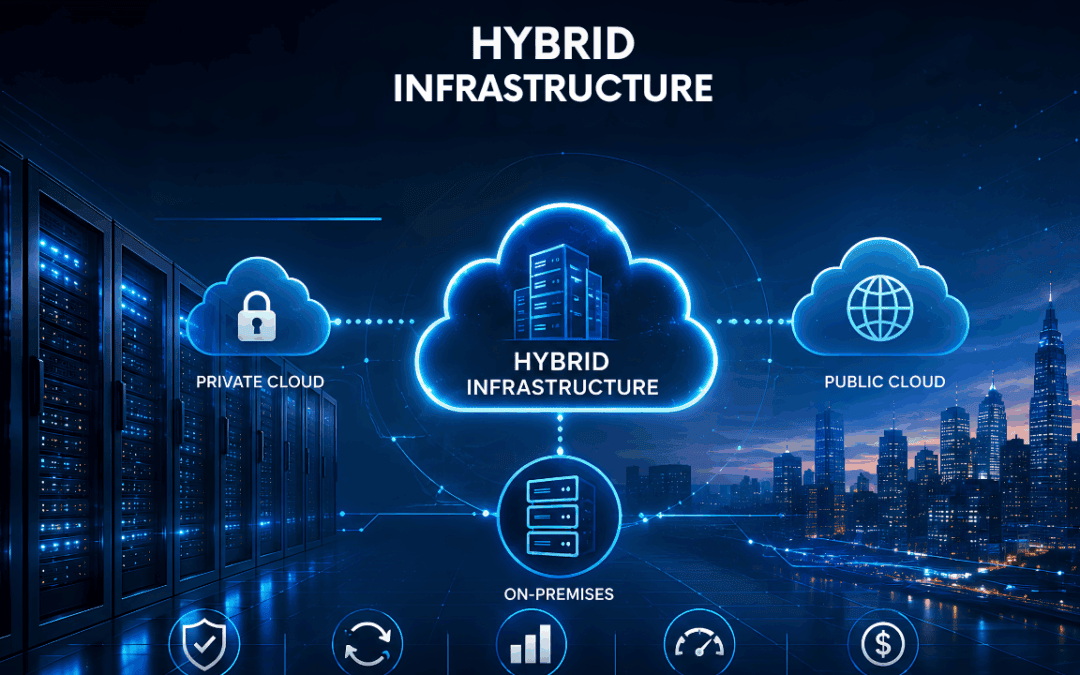
Enterprise IT no longer runs from a single location. Most organizations today operate distributed networks that span on-premises data centers, private cloud platforms, public cloud services from AWS, Azure, and Google Cloud, and edge sites that sit closer to end users. This is hybrid infrastructure, and it has become the default architecture for enterprise IT operations in 2026.
What was once a temporary bridge between old and new is now the operating model itself. The reason is practical. No single environment covers every workload well. Some applications need the compliance and control of on-premises hosting. Others need the elasticity of a public cloud. A growing number need the low-latency response that only edge or regional deployments can deliver. Running all of these together in a coordinated way is what hybrid IT infrastructure is designed to do, and getting it right is what separates enterprises that scale smoothly from ones that spend most of their time firefighting.
What Hybrid IT Infrastructure Means Today
Hybrid IT infrastructure combines multiple hosting environments into a single, coordinated operational model. The most common combination includes on-premises data centers, one or more public cloud providers, and often a private cloud platform. Some enterprises also include managed hosting, colocation, and edge computing in the mix.
The point of hybrid is not just to use multiple environments. It is to run them as one system, where workloads move to wherever they run best, data moves between them where policy and cost allow, and the operations team sees the whole picture rather than a set of disconnected consoles. Modern hybrid cloud offerings from major vendors are built to support this coordination, but achieving it in practice depends more on architecture and operations than on the products themselves.
Large enterprises commonly operate three or more distinct hosting environments simultaneously, and the number is still growing as edge deployments become more common. Hybrid is no longer a transitional state on the way to some other target architecture. It is the target architecture, and the operating models around it need to reflect that permanence rather than treating hybrid as an interim compromise.
The Core Components of a Hybrid Stack
A production hybrid infrastructure typically brings together several distinct environments, each with its own role.
| Environment Type | Primary Role & Use Case | Key Monitoring Requirement |
| On-Premises Data Centers | Workloads requiring total control, strict compliance, or predictable local performance. | Traffic flow and hardware health. |
| Public Cloud Regions | Elastic workloads, rapid scaling, and managed platform services. | Workload performance across AWS, Azure, or GCP. |
| Private Cloud | Sensitive workloads requiring cloud-style agility without public shared infrastructure. | Resource utilization and latency. |
| Edge Sites | Latency-sensitive processing located physically close to users or IoT devices. | Uptime and connectivity reliability. |
| Secure Interconnect | The networking tissue tying all environments together with consistent security policy. | End-to-end visibility across every interconnect path. |
The complexity of a hybrid stack is in the coordination between these layers. This is where data center network monitoring has to extend beyond the walls of the facility itself, because the network path between environments is now part of the data center.
What is Hybrid Cloud Storage?
Hybrid cloud storage refers to a storage architecture that spans on-premises systems and cloud storage services, presented to applications and users as a unified pool. Data can live where it makes the most sense, based on performance requirements, cost, and compliance rules, while still being accessible from wherever it is needed.
- Standard Implementation: On-premises file servers with cloud-based archive tiers.
- Disaster Recovery: Primary storage on-premises replicated to cloud for failover.
- Edge Performance: Cloud-first storage with an on-premises cache for local speed.
The advantage is flexibility. Enterprises can keep “hot” data close to where it is used and shift “cold” data to less expensive storage without changing how applications interact with it. The downside is complexity. Hybrid storage adds visibility gaps, replication lag, and cost surprises when it is not monitored carefully. Storage issues can silently degrade application performance long before they trigger an outright failure, which makes solid infrastructure monitoring one of the specific areas where hybrid storage designs either succeed or quietly fall apart.
Monitoring Across a Hybrid Environment
Visibility is the single hardest problem in a hybrid infrastructure. Each hosting environment produces its own telemetry, in its own format, on its own timeline. Without a coordinated approach to hybrid cloud monitoring, the operations team ends up with fragmented data across five or six consoles and no single view of how the environment is performing.
Splitpoint Solutions provides enterprise-grade IT services powered by Mivu to detect, diagnose, and resolve issues across these hybrid environments. Detecting issues before they affect services shifts operations from reactive firefighting to genuinely preventive maintenance.
Key Pillars of Hybrid Monitoring
- Real-Time Visibility: Single-view access across on-premises, cloud, and edge environments.
- Unified Topology: Visual mapping of how workloads and data flow between disparate environments.
- Cross-Layer Correlation: Linking network, application, and infrastructure signals to find the root cause of issues.
- Intelligent Alerting: Real-time alerts with configurable thresholds to minimize noise.
- Historical Analysis: Deep data sets to support capacity planning and post-incident “blameless” reviews.
The best hybrid monitoring setups feel like a single system. This is where AI network monitoring for distributed networks is changing the game by correlating signals faster than any human operator could.
When to Consider Hybrid Cloud Managed Services
Not every enterprise has the specialized expertise to operate a hybrid infrastructure effectively. Hybrid cloud managed services give enterprises access to external teams that handle the day-to-day operational work: monitoring, patching, incident response, and integration.
The decision to bring in a managed services provider like Splitpoint Solutions usually comes down to two questions:
- Is the internal team large enough to keep pace with the operational complexity?
- Is the current setup delivering the reliability and uptime the business requires?
When the answer to either is no, managed services can close the gap. They allow enterprises to shift focus from maintaining infrastructure to using it for business outcomes. Managed monitoring is a high-value starting point because coordinated visibility is technically difficult to maintain. Many enterprises pair hybrid infrastructure with managed monitoring from the start to avoid the top challenges in distributed network monitoring.
Conclusion
Hybrid infrastructure is the enterprise blueprint for modern IT operations because it is the only architecture that lets organizations match workloads to the environments that suit them without committing everything to a single vendor. However, it is inherently more complex to run.
Success requires treating hybrid as an operational discipline rather than just a procurement decision. Investing in the right tooling and proactive monitoring is what allows these pieces to work together as a unified whole. For more on managed monitoring approaches built for hybrid enterprise environments, visit Splitpoint Solutions.
People Also Ask: Frequently Asked Questions
1. What is hybrid IT infrastructure?
It combines on-premises data centers, public cloud, private cloud, and edge sites into a single coordinated operating model.
2. What are hybrid cloud offerings?
Platforms and services that let enterprises run and manage workloads across multiple environments under one operating model. Observability platforms like Mivu provide the unified visibility layer across these offerings.
3. What is hybrid cloud storage?
A system that combines on-premises and cloud storage into a unified pool for better performance and cost management.
4. Why is hybrid cloud monitoring difficult?
Fragmented telemetry from different vendors leads to blind spots and disconnected monitoring tools that slow down response times.
5. Should we use hybrid cloud managed services?
They are recommended when internal teams cannot keep pace with complexity or when proactive IT support is needed to prevent downtime.