
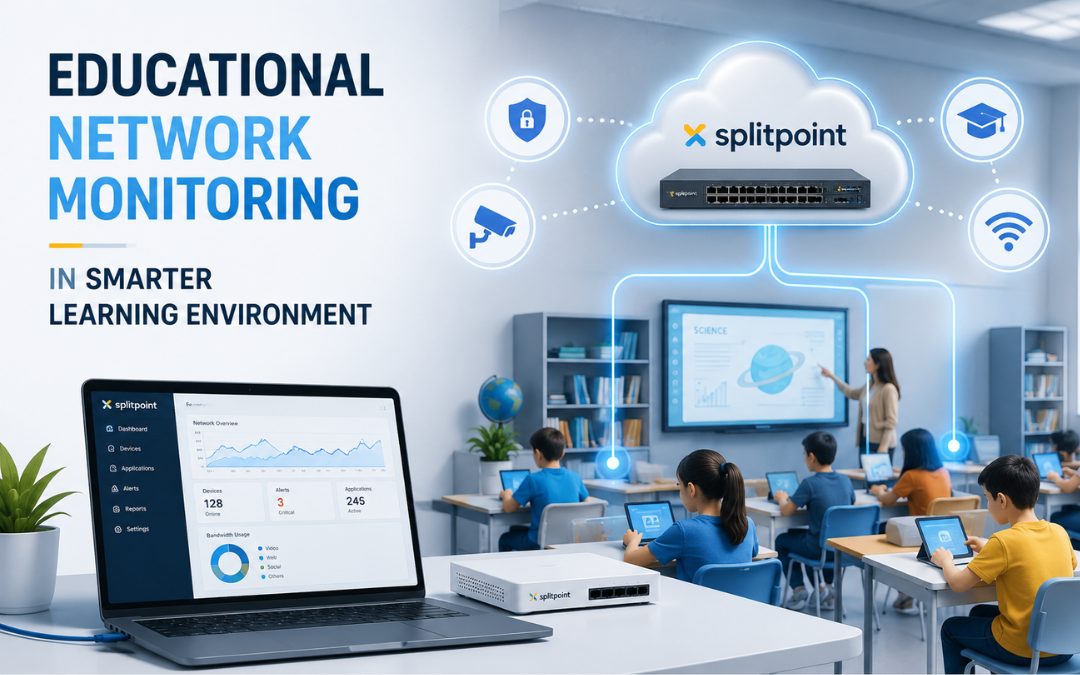
Walk into a modern classroom and the difference from a decade ago is obvious. A teacher pulls up a 3D model on an interactive display, students follow along on tablets, the lesson is being recorded for the three students at home, and an adaptive learning platform is quietly tracking how each student is doing in real time. A few buildings over, a chemistry lab streams a live experiment to a partner school. In the library, a VR headset takes a group of students through a virtual field trip. None of this works if the network underneath it stutters, drops, or slows down at the wrong moment.
This is what a smart learning environment actually is. Not a buzzword, but a stack of connected technologies that have to perform together. And the layer almost nobody outside the IT team sees is the one that determines whether any of it works: the monitoring. Smart learning environment monitoring is what turns the underlying network from a fragile dependency into something that supports the experience instead of disrupting it.
What makes a learning environment smart
A smart learning environment uses connected technology to make instruction more interactive, more personalized, and more measurable. The technology side includes interactive displays, classroom tablets, smart sensors, IoT devices, video conferencing platforms, learning management systems, adaptive learning software, and increasingly augmented and virtual reality tools. The instructional side uses the data those tools produce to adjust teaching in close to real time.
Two things define these environments. First, they depend on multiple systems working at the same time, each with its own network requirements. Second, the experience falls apart in seconds when any one of them slows down. A video lag in a live class breaks the lesson flow. A lab sensor that loses connection interrupts an experiment. An LMS that takes ten seconds to load during a timed exercise wastes class time and frustrates students.
That fragility is why monitoring matters more in education now than it did when classrooms were simpler. The more technology a learning environment uses, the more carefully its network has to be watched, particularly as network latency issues compound with every new connected device.
Why smart classrooms break in ways traditional classrooms do not
A traditional computer lab failed in obvious ways. The internet went down or it did not. Smart learning environments fail in subtle ways that look like teaching problems but are actually network problems.
A tablet that takes a few extra seconds to load each page makes a student fall behind without anyone realizing why. A video stream that drops to lower quality during a guest lecture means the back rows cannot read the slides. A smart board that loses its connection to the LMS in the middle of a lesson sends the teacher hunting through menus while twenty-five students wait. These problems rarely show up as alerts on a basic monitoring tool because the network is not technically down. It is just performing badly enough to ruin the experience.
This is where education network monitoring earns its place. Watching for outright failures is the easy part. Catching the slow degradation that breaks smart learning before students notice is the hard part, and it is where the technology underneath the classroom actually gets judged.
How monitoring keeps smart learning environments running
Modern learning environment monitoring covers more ground than a basic network monitor. It tracks every connected device in every classroom, the access points serving them, the switches behind those, the upstream internet link, and the cloud platforms students and teachers depend on — the same full-stack approach behind broader IT infrastructure monitoring in enterprise settings. Each of those layers can break smart learning in different ways, and the monitoring has to know what good performance looks like at each one.
The work happens in three layers that have to work together. The first is real-time visibility into the infrastructure: switches, routers, access points, and the connections between them. The second is application performance monitoring for the cloud platforms students actually use, from the LMS to video conferencing to AR or VR content delivery. The third is end-user experience monitoring, which measures what is actually happening on a student’s device rather than what the server-side dashboards report.
When all three layers run together, the IT team sees problems in the order students would experience them. A lecture hall starts to lag, the monitoring shows the Wi-Fi controller in that building is overloaded, and the team can intervene before the teacher has to apologize to the class. Most of these incidents trace back to predictable network bottlenecks that show up around the same time every week, which is exactly the kind of pattern monitoring is meant to expose.
Building a managed monitoring approach into the smart learning roadmap
Most schools and districts add new learning technology faster than they update their network monitoring. A district buys interactive panels for every classroom, signs a new contract for a digital curriculum, and rolls out one-to-one devices. The network team finds out about each change after it has already gone live. Smart learning environment network monitoring has to keep pace with all of that, and that only happens when monitoring is part of the planning, not an afterthought.
Three practices help. The first is involving the network team in EdTech procurement decisions, so the monitoring stack can be updated alongside the rollout. The second is using monitoring data to inform what comes next. If the data shows the Wi-Fi in the science wing struggles during peak periods, that is the building where the next access point upgrade should go — a version of the same distributed network monitoring challenges faced by any multi-site organization. The third is treating monitoring as a continuous service rather than a one-time setup. A managed network monitoring approach handles this for IT teams that do not have the headcount to run it themselves.
The schools that get this right tend to share something in common. They treat the monitoring stack as part of the learning environment, not as a separate IT concern. The same way HVAC has to work for a classroom to be usable, the network has to perform for a smart classroom to deliver on what was promised when the technology was bought.
Smart learning depends on what teachers and students never see
The best smart learning environments are the ones where the technology disappears. A teacher launches an interactive lesson and it just works. A student joins a remote class and the video is clear. A research group runs a simulation in a connected lab and the data streams without hiccups. This invisibility is the point, and it is only possible when the network underneath is being watched closely enough to catch problems before anyone in the room notices them.
This is also where most of the work in education IT actually sits. The visible projects, new devices, new platforms, new buildings, get the budget and the attention. The invisible work, monitoring the network so all of that visible work can deliver, is what determines whether the investment actually pays off in better learning outcomes.
Conclusion
A smarter learning environment is not the result of buying smarter devices. It is the result of running the underlying technology so reliably that students and teachers stop thinking about it. Educational network monitoring is what makes that possible, and it is what most schools underestimate when they plan their next round of EdTech investment. The classroom looks the same whether the network is being monitored well or not, right up to the moment something breaks during a live lesson. By then, it is too late.
For more on managed monitoring approaches built to support modern learning environments at scale, visit Splitpoint Solutions.
People Also Ask: Frequently Asked Questions
1. What is a smart learning environment?
A smart learning environment uses connected technology like interactive displays, tablets, IoT sensors, LMS platforms, and adaptive learning tools to make instruction more interactive, personalized, and data-driven. It depends on a reliable network to function.
2. Why does smart learning need network monitoring?
Because the experience breaks when the network slows down, not just when it fails. Monitoring catches the small performance drops that disrupt lessons before students or teachers notice them.
3. What is the difference between regular and modern learning environment monitoring?
Regular monitoring watches devices and connections. Modern learning environment monitoring also watches application performance, end-user experience, and the cloud platforms students rely on, because problems at any of those layers can ruin a lesson.
4. How does monitoring affect classroom technology like interactive boards or VR?
These tools need stable, low-latency connections. Monitoring tracks the performance of the Wi-Fi, switches, and cloud services they depend on, and flags issues before the technology fails in front of a class.
5. Can monitoring help schools manage growing EdTech investments?
Yes. The data shows where the network is struggling, which informs where infrastructure upgrades should happen and whether the next EdTech rollout will actually work in the environment it is going into.
6. Is monitoring more important in K-12 or higher education?
Both, for different reasons. K-12 districts deal with multi-site coverage and tight budgets. Universities deal with scale, dorms, and research traffic. The underlying need is the same: keep smart learning running reliably.