
The performance of your infrastructure can make or break your business. Effective infrastructure monitoring isn’t optional anymore. It’s a core part of keeping operations running and user experience consistent. This guide covers the basics, the tools available, and the practices that actually catch problems before they hit your users.
We’ll walk through the key metrics to track, the types of monitoring tools available, and the best practices that help teams get ahead of issues instead of reacting to them after the fact.
Understanding Infrastructure Monitoring
Infrastructure monitoring refers to the process of gathering, examining, and leveraging data concerning the different elements of an IT infrastructure as a system. This encompasses servers, databases, networks, applications among other critical systems. The main aim is to make sure that all these elements are operating at their best and to detect and fix any problem before it reaches the end-users. Monitoring allows you to have real-time information on the health of your infrastructure, which will help you proactively manage and maintain it.
Effective infrastructure monitoring involves more than just tracking system uptime. It includes performance measurements, capacity planning and security monitoring. Through the constant gathering of data, organizations will be able to create baselines, identify anomalies, and forecast the future trends. This predictive nature is necessary to guarantee high availability, as well as the allocation of resources in a way that is most efficient and scalable, and therefore ensures that systems are in operation, as well as efficient and scalable.
More to the point, there is no universal infrastructure monitoring solution. It needs a personal situation depending on the needs and priorities of an organization. Such customization would entail the selection of the appropriate tools, the establishment of the right thresholds, and relevant metrics. With the help of comprehending and introducing a holistic approach to monitoring, companies will be able to turn their infrastructure into an oiled machine, which is capable of surviving in the environment of the modern digital world.
The Importance of Infrastructure Monitoring for Businesses
Infrastructure monitoring is of utmost importance to businesses. In the world where downtime means lost revenues and damaged reputations, having a strong and sturdy IT infrastructure is of the utmost importance. Businesses can gain visibility of their infrastructure by monitoring it to ensure that it is operational at all times, reduce the risk, and improve the user experience. It serves as the initial mode of correction and detection of probable problems before they get out of control.
Infrastructure monitoring has one of the most significant advantages, namely the increased efficiency of operations. With real-time data and insights, IT teams can be able to spot bottlenecks within a short time, optimization of resource utilization, and enhancement of system performance. This efficiency can be converted into cost efficiency because the companies are able to save money by not over-provisioning the resources and save it on time lost on manual diagnosis. In addition, automated monitoring minimizes the chances of possible human error, which also improves reliability.
The other important factor is the possibility of improving security. As cyber threats keep rising, constant monitoring helps businesses to identify and address possible security incidents within a short period. Through pattern analysis and anomalies detection, organizations are able to detect suspicious activity and take real time action in order to protect their systems. This preventive security strategy is fundamental in safeguarding sensitive information and keeping the customers in check.
Key Components of an Effective Monitoring Strategy
A good monitoring plan is developed on a number of important elements that combine to give a total transparency and control of the infrastructure of an organization. The first one is the data collection which entails the collection of the measurement of performance and logs of the performance of different sources in the infrastructure. This data would be the basis of every monitoring activity, and it would be the raw information to evaluate the health and performance of the system.
The second element is analysis and visualization of data. After gathering data, it should be processed and analysed to get meaningful information. This entails the application of tools and techniques to help in identifying patterns, anomalies, and produce reports. Visualization tools such as dashboards and graphs play a crucial role in presenting this data in an easily understandable format, allowing IT teams to quickly interpret and act on the information.
The third component is alerting and notification. Effective monitoring requires a mechanism to alert IT teams when predefined thresholds or anomalies are detected. This ensures that potential issues are addressed promptly, minimizing the impact on operations. Alerts can be customized based on the severity of the issue and can be delivered through various channels such as email, SMS, or integrated communication platforms. Types of Infrastructure Monitoring Tools
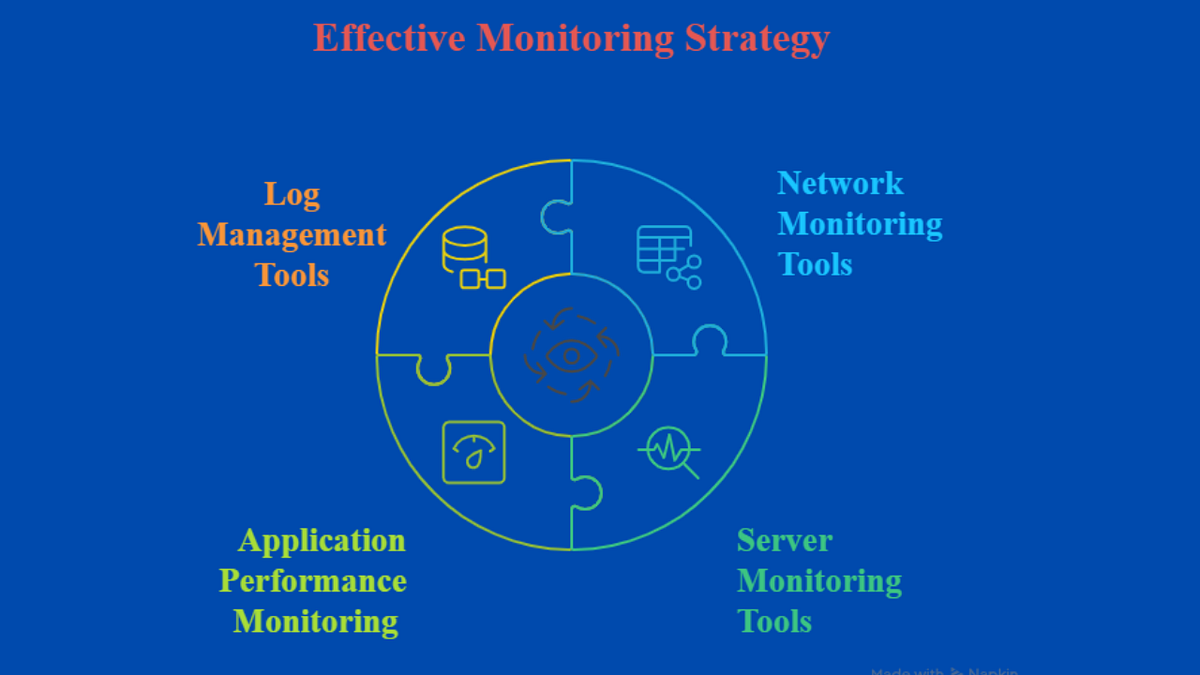
There is a wide range of tools available, each designed to address specific aspects of infrastructure monitoring infrastructure. These tools can be broadly categorized into several types:
1. Network Monitoring Tools
Network monitoring tools are concerned with the health and performance of network elements including routers, switches and firewalls. They give an insight into the network traffic, the bandwidth utilization, and network connectivity problems.
Examples SolarWinds Network Performance Monitor, PRTG Network Monitor.
2. Server Monitoring Tools
Service monitors trace the behavior and well being of the physical and virtual servers. They check such metrics as CPU load, memory consumption, disk I/O and system uptime. These tools are used to make sure that the servers are performing effectively and are capable of performing the work.
Examples: Nagios, Zabbix, Datadog.
3. Application Performance Monitoring Tools (APM)
APM tools are meant to audit the performance of applications and their availability. They offer information regarding the response time of applications, the number of errors, and experiences of users. APM tools are useful in determining the performance bottlenecks of the applications and in minimizing the performance of the applications.
Examples: New Relic, Dynatrace, AppDynamics.
4. Log Management Tools
The log management tools gather, analyse and control logs created by different parts of the infrastructure. These aids will assist in the process of troubleshooting, security audit, and compliance.
Examples: Splunk, ELK Stack (Elasticsearch, Logstash, Kibana), Graylag.
Best Practices for Implementing Infrastructure Monitoring
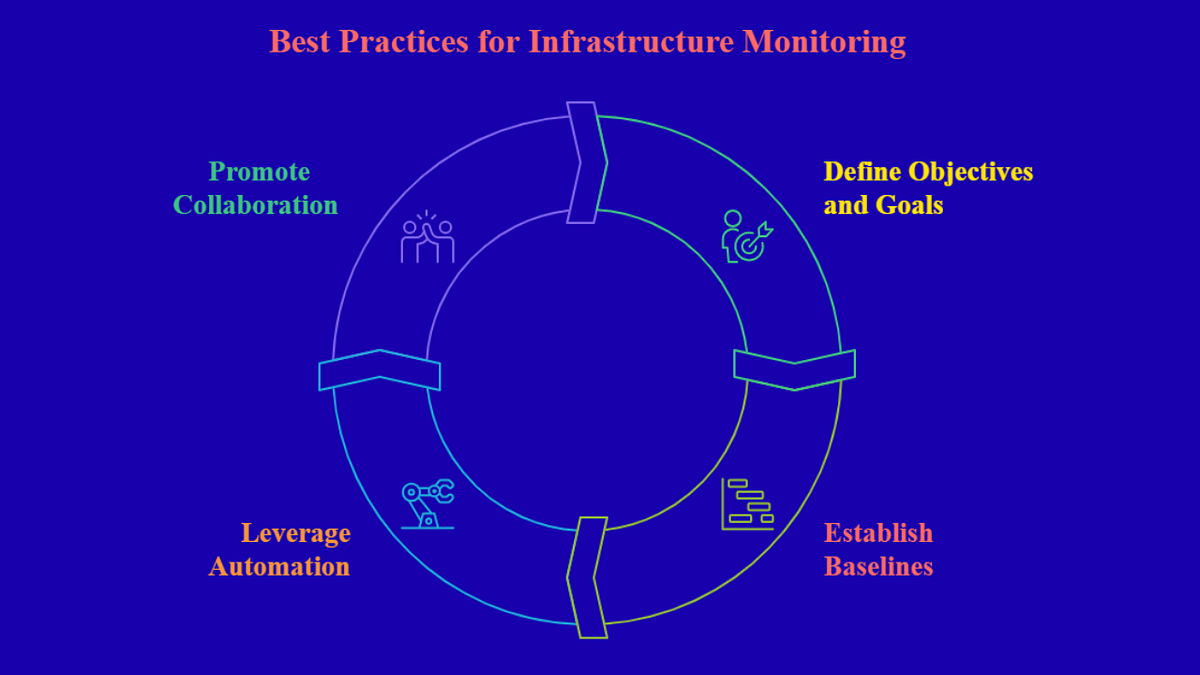
- Define Clear Objectives and Goals: Determine the goal you have using infrastructure monitoring, and it can be to enhance the performance or to secure the infrastructure or even to comply with the stipulations. Clear objectives assist in defining the appropriate tools, measurements, and methods in order to track effectively.
- Establish Baselines for Normal Performance: You should monitor your infrastructure over time to know how it is supposed to be. Setting performance limits will enable you to identify abnormalities or irregularities in early stages. Periodically revise these baselines based on the change in infrastructure and workloads.
- Leverage Automation: Automate the data collection, analysis, and alerting processes to minimize the possibility of human error and have constant monitoring. Automation also liberates the IT teams to work on more advanced duties and strategic projects as well as enhance productivity.
- Promote Collaboration and Communication: The IT team should not be the only people who are observed. Involve other departments with security, operations and development. Sharing insights and reports regularly to keep things on track and make infrastructure management proactive.
Common Challenges in Infrastructure Monitoring and How to Overcome Them
Although the advantages are many, infrastructure monitoring is associated with a number of problems. The first hurdle is, one, the large amount of data produced by monitoring tools. Overload of information can also be a result of huge amounts of data which is difficult to handle. In order to counter this predicament, data filtering and data aggregation methods have to be put in place.
It is the ability to extract actionable insights without being lost in the plethora of information that will ensure organizations can achieve this by concentrating on important metrics and tools that can be used to intelligently filter and correlate data.
The other issue is making sure that monitoring data is reliable and accurate. Incorrect data may result in false positives or negatives and generate unwarranted alerts or overlooked problems. In order to solve this challenge, it is important to ensure that the monitoring tools are regularly checked and verified. This includes performing cross-referencing on information held by various sources, routine audits and narrowing of the threshold so that the monitoring system is delivering accurate and reliable information.
Another challenge is scalability, particularly to the companies that have a fast growth rate. With the increase in infrastructure, the monitoring systems should also increase in order to absorb the load. This requires scalable monitoring tools and architectures that can accommodate additional data sources and processing requirements. Cloud-based network monitoring solutions can offer the flexibility and scalability needed to adapt to changing infrastructure demands.
Key Metrics to Track for Optimal Performance
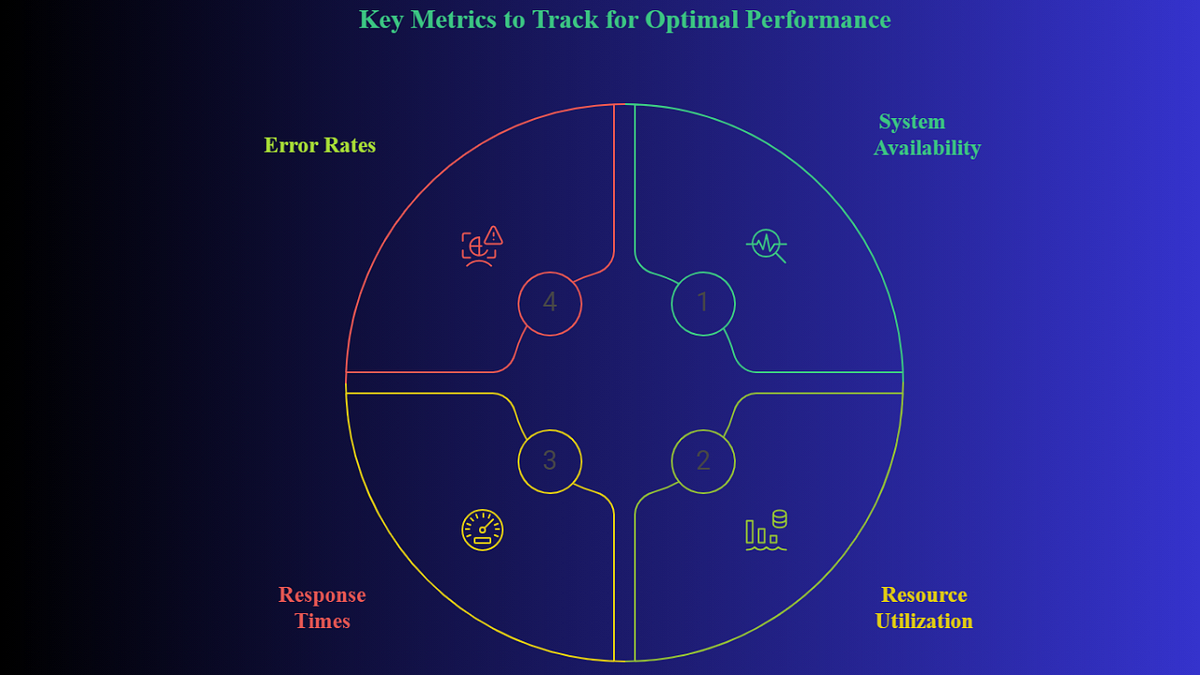
It is important to monitor the appropriate metrics to streamline infrastructure and monitoring of networks. Key metrics include:
- System Availability (Uptime): This is a measure of the availability of systems. Identifies and provides solutions to problems such as hardware or network malfunctions.
- Resource Utilization: Measures CPU and memory and disk I/O utilization to identify bottlenecks or over-provisioned resources to allocate resources more effectively.
- Response Times: Determines the speed with which systems respond to requests. Slow response means that there are performance problems that should be optimized.
- Error Rates: Monitors frequency and type of errors to find bugs, misconfiguration or hardware problems and reduce downtime.
Case Studies: Successful Implementation of Monitoring Solutions
Practical cases of existing infrastructure monitoring implementations can be of great help and motivation to organizations that want to improve monitoring measures. A case study example is based on a big e-commerce company who adopted an extensive monitoring solution to make sure that the performance and reliability of its online platform will be guaranteed.
The company experienced frequent downtime and performance problems that cost the company revenue and the dissatisfaction of the customers. With the implementation of the network monitoring, server monitoring, and application performance monitoring tool combination, the company could have a full view of its infrastructure. The monitoring solution offered real time information about systems health, metrics of performance and possible trouble.
The monitoring solution in place allowed the company to know the performance bottlenecks early enough and deal with them beforehand, maximize resources, and guarantee high availability. The outcome was a tremendous decrease in the downtime, enhanced customer satisfaction, and user experience. Another area the company saved cost was in the allocation of resources and also minimization of manual troubleshooting.
The second case study is concerned with a financial organization that introduced a monitoring solution to achieve compliance and security. The company had to guarantee sensitive financial information security and adherence to regulatory needs. Using log management and security monitoring tools, the institution could gather and analyse logs of different systems and identify anomalies, as well as act upon the possible security incidents.
The monitoring solution was useful in terms of giving useful insights on the users activities, system access and security threats that could be present. This helped the institution to address security threats promptly and avoid them, and secure sensitive information and adhere to regulatory expectations. There was also an increase in the operational efficiency and the risk of security breaches minimized by the institution.
Future Trends in Infrastructure Monitoring
Infrastructure monitoring is an ever advancing field that is subject to technological developments and shifting business requirements. A number of new trends are defining the future of infrastructure monitoring, which presents new opportunities and capabilities to organizations.
Among the important trends is the growing use of artificial intelligence (AI) and machine learning (ML) in monitoring solutions. The monitoring capabilities can be optimised with the help of AI and ML, which will automatise data analysis, identify anomalies, and forecast possible problems. These technologies are able to find patterns and correlations that cannot be easily discovered using traditional monitoring techniques and offer more insight and accurate forecasting.
The other trend is the prevailing focus on observability. Observability is more than a traditional form of monitoring in that it presents a system-wide view of the system itself, its internal states and behaviours. It means gathering and examining information regarding different sources, including logs, metrics, and traces to obtain the whole picture of system performance. Observability helps organizations to diagnose problems and fix them, improve performance, and end user experiences faster.
Infrastructure monitoring is also being affected by the increase of the cloud-native environment and microservices. With the adoption of cloud-native technologies and the implementation of applications in the form of microservices, monitoring solutions should be changed to address the complexity and dynamism of these environments. It demands monitoring tools that are able to give finer visibility, monitor dependencies and follow-up performance of distributed components.
Conclusion
Infrastructure monitoring is one such element of infrastructure management in the contemporary world. Monitoring helps organizations to proactively maintain their infrastructure, manage resources and achieve high availability by offering real-time information about the health, performance, and security of their system. Successful monitoring is based on the key to outline clear goals, choose appropriate tools, and follow the best practices.
The rewards of good network Monitoring and infrastructure monitoring are far greater than the efforts required to implement them. Organizations using extensive monitoring systems are able to enjoy high efficiency in their operations, enhance security, and positive experiences among the users. Bleeding the future and leading the trend by adopting new technologies like AI and observability, companies will be able to make the most of their infrastructure and become successful in the modern digital environment.
When you are setting out on your mission to uplift your infrastructure management strategy, the lessons to keep in mind are that monitoring is not a one-time thing but a continuous process. Always keep improving on your method of monitoring, evolve with the evolving needs and use the strength of data to make good decisions. Now that you have the proper monitoring strategy, you are able to make your infrastructure a powerhouse of reliability and efficiency, able to scramble up to the demands of the future.