
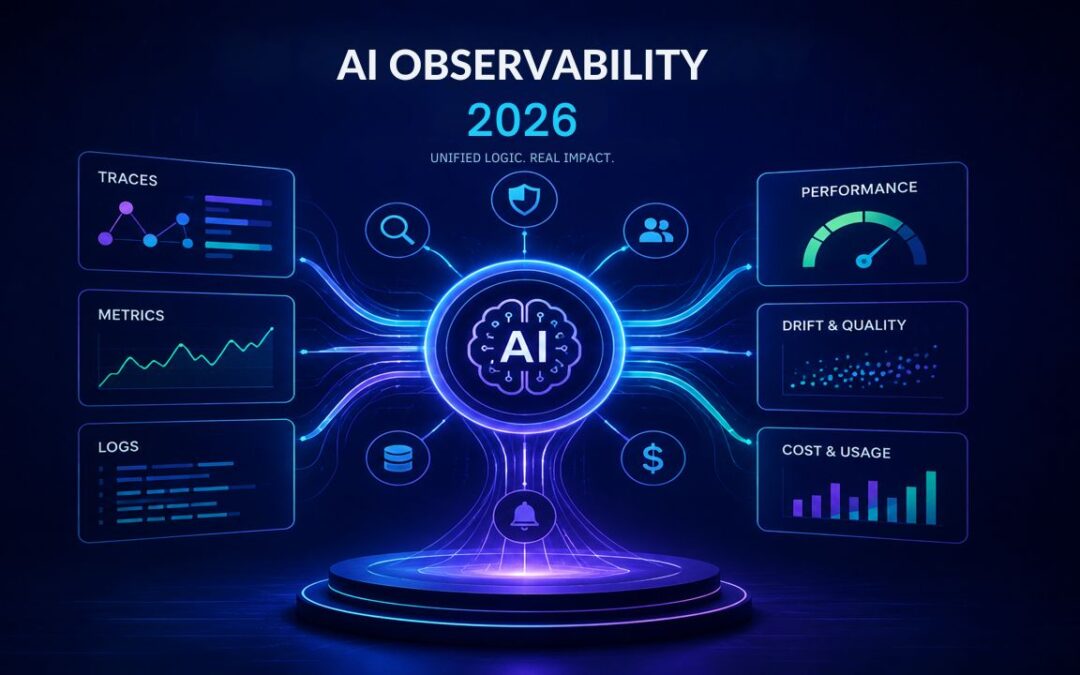
Datadog, Dynatrace and Grafana have all bet 2026 on AI-driven operations. Here is the prerequisite they understate — and why infrastructure monitoring, predictive alerts, data latency and network reliability still decide who wins.
What is the prerequisite for AI-driven observability in 2026?
AI-driven observability requires a unified data foundation across network, infrastructure and applications — not smarter agents on top of fragmented telemetry. Mivu delivers this through real-time correlation of packet loss, latency, jitter and application traces, with lightweight probes across the entire infrastructure and AI-powered SLA detection, all built around the network performance metrics that actually predict failure.
The 2026 observability market is converging on a single thesis: AI agents will run operations. Every major vendor — Datadog, Dynatrace, Grafana Labs — is rebuilding around it. But the unstated requirement underneath the predictions is the same one infrastructure monitoring teams have wrestled with for a decade: unified data. Without predictive alerts, low data latency, and the network reliability to deliver telemetry in real time, an AI agent has nothing trustworthy to act on. This is why Mivu treats unified logic — not autonomy — as the operational substrate of the next observability cycle.
1. Three competitors, one identical thesis
Inside the last 90 days, the three loudest vendors in observability have all moved toward the same position. Datadog launched the Datadog MCP Server to expose telemetry to AI agents in real time. Dynatrace published “Six observability predictions for 2026,” framing observability as the control plane for agentic operations. Grafana Labs released Grafana 13 at GrafanaCON 2026 under the banner “get value from your data faster,” with Loki delivering up to 20× less data scanned on aggregate queries. This race to consolidate telemetry mirrors the same push toward network security tools that correlate rather than isolate signal.
Three different vendors. Three different audiences. One identical thesis: in 2026, the value of your observability platform will be measured by how usable its data is for autonomous systems, not by how many dashboards it can render. That is a true and useful signal. It is also incomplete.
2. Unified Logic: why log management is not the answer
Grafana, Splunk and the wider log-aggregation cohort have spent the last decade making logs cheaper, faster and more searchable. Loki 2026’s twenty-times-less-data improvement is genuinely impressive engineering. But faster log access does not change what a log is: a record of what happened inside one component, after the fact. Logs alone cannot explain whether the application slowdown your customer felt was caused by a memory leak, an upstream packet-loss spike on a transit link, or a misconfigured load balancer rebalancing flows — the kind of root-cause question network performance monitoring is built to answer.
That is the Unified Logic gap. Logs are useful only when they are correlated, in real time, with the network and infrastructure context that produced them. Mivu’s distributed tracing capabilities correlate traces with logs, infrastructure metrics, database queries, network calls and frontend telemetry — inside one investigation. The investigator (human or AI) never leaves the platform to follow a problem from a port to a payment.
3. Predictive Scale: why agentic operations need anomaly detection first
Dynatrace’s 2026 predictions warn — correctly — that powerful agents amplify errors, because inaccuracies compound across agent interactions. The implication is rarely stated this directly: an AI agent operating on lagging or fragmented data does not just fail to add value, it makes failure faster and more confident.
Predictive Scale is the alternative discipline. Instead of reacting after a threshold breach (the cohort that Datadog and Dynatrace are arming with smarter agents), Predictive Scale uses anomaly detection on real-time observability data to act before the threshold is breached. Mivu’s AI-powered detection identifies performance spikes and SLA deviations early, while proactive alerts notify IT teams of potential problems before they become critical — inside the window where action is still preventative, not remedial.
In our deployment with enterprise clients managing distributed networks, our lead engineers have observed that the bottleneck is rarely the agent’s analytical capability; it is the time investigators spend stitching three or four tools together to reach a single root cause. Unified observability collapses that stitching to zero. Predictive Scale becomes possible only after it does.
MIVU LABORATORY INSIGHT
Across distributed-network deployments, our internal observation is that mean-time-to-diagnose is dominated not by analytical complexity but by tool-switching cost. When a single investigator query spans real-time packet-loss telemetry, infrastructure metrics, database query traces and frontend session data, the investigative path reduces significantly. The same advantage flows to an AI agent the moment one is plugged in: it is reasoning over correlated signal, not assembling it.
4. The three prerequisites every 2026 observability buyer underestimates
4.1 Unified telemetry across the three pillars
Most IT teams already collect metrics, logs and traces. Far fewer can correlate a network packet-loss spike to the application latency it caused and then to the customer it affected — inside one investigation, in real time. Split signals defeat the agent thesis, because the agent has to stitch them back together at decision time, and that is precisely where hallucination enters. Mivu was designed so that this stitching is not required.
4.2 Real-time signal fidelity, not aggregates with lag
Five-minute rollups are fine for an executive dashboard. They are not fine for autonomous remediation: by the time a five-minute aggregate sees a problem, the agent’s response window is already gone. Mivu’s real-time monitoring of network devices, ports and links — with threshold-based proactive alerts and continuous packet-loss, latency and jitter tracking — is the prerequisite that lets any later automation react inside the window where reacting still matters.
4.3 Predictable economics that let you keep all the data
Competitors do not lead with this. The agentic-AI story assumes you will keep more data, query it more often and pipe it into more downstream consumers. Pricing models with consumption overages and per-host surcharges work against that assumption. Mivu’s pricing is monthly subscription with predictable costs and no surprise overages — the question “can we afford to keep this signal?” stops being a daily trade-off.
5. Mivu vs. generic single-vendor observability — at a glance
| Capability | Generic single-vendor observability | Mivu unified observability |
|---|---|---|
| Cross-pillar correlation (network ↔ infra ↔ app) | Often three tools, three query languages, manual stitching at decision time | One platform: traces correlated with logs, infra metrics, database queries, network calls and frontend telemetry |
| Real-time signal fidelity | Five-minute rollups typical for dashboards; alerting lag affects autonomous remediation windows | Real-time tracking of packet loss, latency, jitter and traffic patterns; threshold-based proactive alerts |
| Deployment model | Heavy per-host agents or sampled coverage | Lightweight probes deployed across the network for comprehensive coverage with minimal operational disruption |
| Pricing predictability | Consumption + per-host overages create a “can we afford to keep this signal?” dilemma | Monthly subscription with predictable costs; no surprise overages, no hidden fees |
| Foundation for AI-driven operations | Adds an AI layer on top of fragmented telemetry — automates blind spots faster | Provides the unified, real-time data foundation any future agent must operate on to be trustworthy |
6. What this means for your 2026 plan
If you are a CIO, IT director or head of operations reading the same competitive announcements we are, here is the honest framing: do not buy the agent first. Buy the data foundation first, and then choose — with evidence — which agents you trust enough to plug into it. The vendors leading the AI-observability narrative are correct about the direction. They are silent about the prerequisite, because it is less exciting and harder to sell as a feature.
Mivu is the prerequisite. A unified observability platform that gives you real-time visibility across network, infrastructure and applications, with the integrations, fidelity and economics that make the 2026 predictions a plan rather than a press release.
Continue reading on Mivu
- Service page — Reliable Network Monitoring on Mivu
- Service page — Infrastructure Monitoring with Mivu
- Service page — Application Performance Monitoring (APM)
See your full stack the way an AI agent would need to.
Book a 30-minute Mivu demo. Our lead engineers will map your network, infrastructure and application telemetry into one unified view — live, on your own data.