

Modern businesses no longer run from a single office. They operate across multiple locations, remote sites, cloud platforms, and data centers—all connected through one network. When that network is spread across different environments and geographies, managing it becomes a serious challenge. The bigger the footprint, the harder it is to keep everything visible and running smoothly.
This is the reality for most mid-to-large organizations today. If your moanitoring strategy has not kept pace with how your network has grown, problems will find you before you find them.
What Are Distributed Networks and Why Are They Hard to Monitor
A traditional network lives in one place. Everything is connected locally. You know where the devices are and what they are doing.
A distributed network is the opposite. Traffic moves across branches, cloud environments, remote workers, and multiple ISPs — all at the same time. Each segment behaves differently, and a problem in one location can ripple through the entire organisation before anyone identifies where it started.
That gap between network complexity and monitoring capability is where most IT issues begin. Organizations managing distributed networks often discover blind spots only after something has already gone wrong.
The Challenges of Monitoring Distributed Networks
The challenges of monitoring distributed networks go beyond the technical. They are structural and operational too.
Most monitoring tools were built for centralized environments. When you stretch them across multiple sites and cloud layers, you end up with disconnected dashboards—each showing part of what is happening, none showing the full picture. Your team spends time chasing data across different tools instead of resolving the actual issue. This is why proper network monitoring designed for distributed environments matters — it brings every segment into one view so your team can work from a single, accurate source of truth.
Scaling without losing visibility is another challenge teams consistently underestimate. Adding new locations or cloud workloads means adding monitoring complexity. Tools that work fine for ten sites often struggle at thirty. Coverage gaps appear quietly — and those gaps are where outages hide.
Alert fatigue is the third major problem. Distributed networks generate enormous amounts of telemetry. Without smart filtering, teams get buried in low-priority notifications and miss the critical ones. When every alert feels urgent, response slows down — and that is exactly when real problems slip through.
Diagnosing Network Latency and Performance Issues Across Distributed Sites
Performance inconsistency across locations is one of the most frustrating parts of managing a distributed environment. One office runs fast and performs reliably. Another site deals with delays throughout the working day.
Diagnosing network latency across multiple hops, ISPs, and cloud paths requires continuous visibility at every hop — not occasional manual checks. Without location-aware data, your team cannot tell whether the issue is a local device, a WAN link, SD-WAN overlay, or a cloud path. That uncertainty turns what should be a manageable performance issue into hours of investigation with no clear answer.
A Simple Framework for Distributed Network Monitoring
Rather than adding more tools, distributed monitoring needs a clear and consistent structure. The CLEAR Framework gives IT teams a repeatable model to follow:
- C—Centralized Visibility across all sites, clouds, and devices
- L—Location-Aware Metrics so problems surface at the right geographic layer
- E—End-to-End Correlation connecting data across every segment
- A—Automated Alerting with smart thresholds that reduce noise
- R—Real-Time Response so teams can act before users are impacted
Each layer supports the next. Without centralized visibility, your alerting will not be reliable. Without reliable alerting, real-time response becomes impossible. This is a system, not a checklist.
Solutions for Distributed Network Monitoring
The most effective solutions for distributed network monitoring begin with how you collect data.
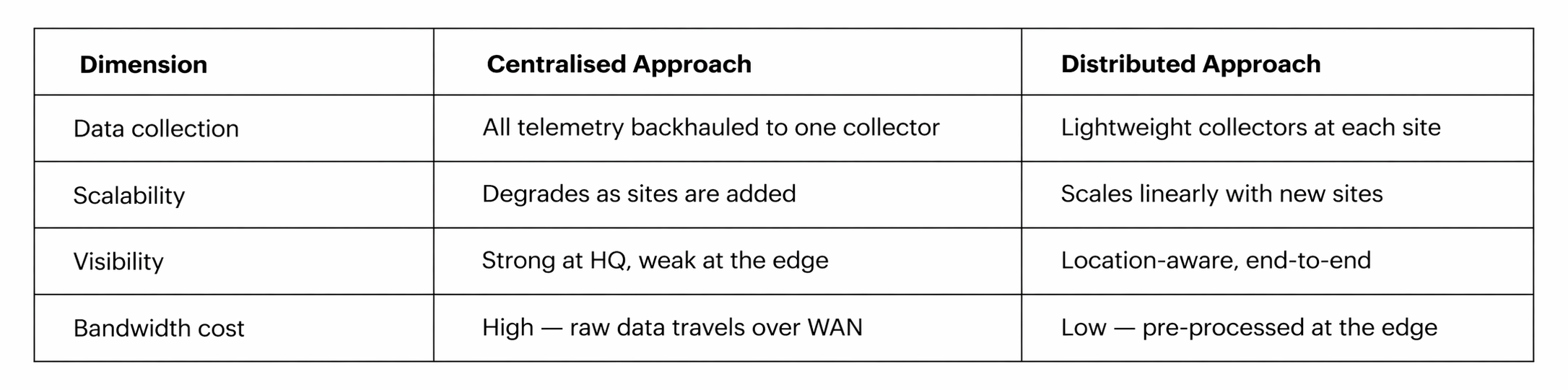
Placing lightweight collectors at each site — rather than backhauling every packet to a central aggregation point — reduces overhead and gives you more accurate, location-specific telemetry. Each site reports on its own behaviour, with data feeding into a single management layer for correlation. This is what makes monitoring scalable as your environment grows.
In distributed environments, slow applications are frequently blamed on the network when the actual cause sits elsewhere in the stack — the database, the server tier, or the application itself. Connecting application performance monitoring to your network data helps isolate whether a slowdown is a network, infrastructure, or application issue — rather than troubleshooting each layer in isolation.
Synthetic monitoring adds a proactive layer. By simulating traffic between sites and measuring performance continuously, your team gets early warning of degradation before users are affected. Used alongside real-user monitoring, it shifts your posture from reactive to preventive.
Distributed Network Monitoring Best Practices: What Actually Works
Most teams overcomplicate distributed network monitoring by stacking tools on top of tools, hoping more visibility means fewer problems. It does not. What actually works starts with three unglamorous decisions. First, standardize how every site, device, and cloud segment reports data so your systems speak one language. Second, make every alert context-rich enough to act on immediately, rather than simply logging that something went wrong. Third, review your monitoring strategy on a regular cadence — because your network never stops changing, even when your approach does. The networks that run cleanly are not the ones with the biggest monitoring budgets — they are the ones built on a clear, consistent strategy that adapts as fast as the environment around it.
Centralised vs Distributed Monitoring: A Quick Comparison
Suggested new section to add depth and word count (helps ranking). A short comparison table like the one below would earn featured-snippet eligibility:
Conclusion
Distributed networks are the standard for growing organizations. Nearly every business managing complex IT infrastructure is dealing with multi-site, hybrid, or cloud-extended environments—whether they have a structured monitoring plan for it or not.
The challenges are real: fragmented visibility, performance inconsistency, scaling gaps, and alert fatigue. But each one is solvable when you approach it with the right structure and tooling built for how distributed environments actually work.
Splitpoint Solutions provides managed monitoring services purpose-built for complex, distributed environments. From unified dashboards to real-time alerting and deep network visibility, we give IT teams the full picture—across every site, every cloud layer, and every endpoint—in one place.
Frequently Asked Questions
What are the main challenges in monitoring distributed networks?
Key challenges include limited visibility, complex architectures, latency issues, data silos, and troubleshooting difficulties. Managing multiple endpoints and ensuring consistent performance across regions makes monitoring distributed networks more complicated than traditional setups.
Why is network monitoring important in distributed systems?
Network monitoring helps detect performance issues, reduce downtime, and ensure system reliability. It provides real-time insights into network health, allowing IT teams to quickly identify and resolve problems before they impact users or business operations.
What is the role of observability in distributed networks?
Observability goes beyond traditional monitoring. While monitoring tells you whether known problems are occurring, observability — built on the three pillars of logs, metrics, and traces — lets teams ask new questions about system behaviour without shipping new code. In distributed networks, this is essential for diagnosing issues that span multiple services, sites, and cloud layers.
How can businesses improve distributed network reliability?
Businesses can improve reliability by implementing robust monitoring systems, automating alerts, using redundancy, and regularly analyzing performance data. Proactive maintenance and continuous monitoring help prevent failures and ensure stable network operations.
How does downtime impact distributed networks?
Downtime can disrupt operations, affect user experience, and lead to financial losses. Effective monitoring helps detect issues early, reducing downtime and ensuring continuous availability of services across distributed environments.