

In today’s hyper-connected world, network efficiency is the backbone of seamless communication and business operations. Discover why real-time user experience management is vital for better performance, happier users, and growth—boosted by APM services. By pinpointing and addressing these seven essential factors, you can not only enhance connectivity but also optimize resource allocation and improve user experience. Join us as we dive into the intricacies of network performance, offering insights that can transform your approach to connectivity and empower your operations like never before. Embrace the opportunity to elevate your network, ensuring it meets the evolving demands of your organization and beyond.
Understanding Network Efficiency
Network efficiency is an important element in contemporary business running, which guarantees effectiveness of communication and easy connectivity. What is network efficiency, however? Network efficiency at its most fundamental sense is the capability of a network to properly address data transfer and communication tasks with little delays and high reliability. It also covers a range of technical features such as throughput, latency, and the reliability of the system in general, which combined can define the levels of performance of a network under varying circumstances.
Network efficiency is a dynamic index and this changes with the advent of new forms of technology and the alteration in the needs of the network. To stay competitive, an organization should constantly review and optimize its network to manage the growing amount of data and provide rapid and uninterrupted communication. In addition, network efficiency is inextricably linked to the user experience; an efficiently designed network can make the user experience much better due to the increased speed and reliability of the network.
To appreciate why network efficiency is a complicated issue, it is necessary to delve into the issues that affect it. These can be hardware capabilities and software setup to conditions in the environment and user actions. The analysis and solution of these variables can open greater opportunities of network performance to organizations and this will result in increased productivity, cost reduction and enhanced communication infrastructure .Let’s delve into the importance of network performance and the key factors that impact it.
The Importance of Network Performance
Network performance is an essential part of contemporary business, as it lays the basis of both basic communications and the most crucial data transfers. High network performance is defined as the ability of the network to transmit the data packets as fast and reliable as possible with minimal delays being experienced and no bottlenecks that may cause disruption in the business process. In a time where money is time, even a network slowdown can cost a lot of money and even cause an opportunity.
Performance of networks has one of the strongest reasons to be prioritized and this is its direct influence on productivity. Work in an effective network is done faster and with more efficiency, the employees are able to concentrate on value addition work and not struggling to debug a network problem. This improved performance may result in increased innovation, quicker decision-making and eventually, improved competitive advantage in the market.
Moreover, network performance is essential in supporting positive user experience. Whether employees using cloud-based networks or customers using digital services of a company, a well-functioning network with smooth and fast operations is a key to satisfaction and loyalty. This may result in frustration, demotivation, and the business may be lost because of poor network performance. Thus, the issue of investing into performance of the network is not only a technological matter but a matter of creating the basis of the success and sustainability in the digital world.
Key Factors Affecting Network Efficiency
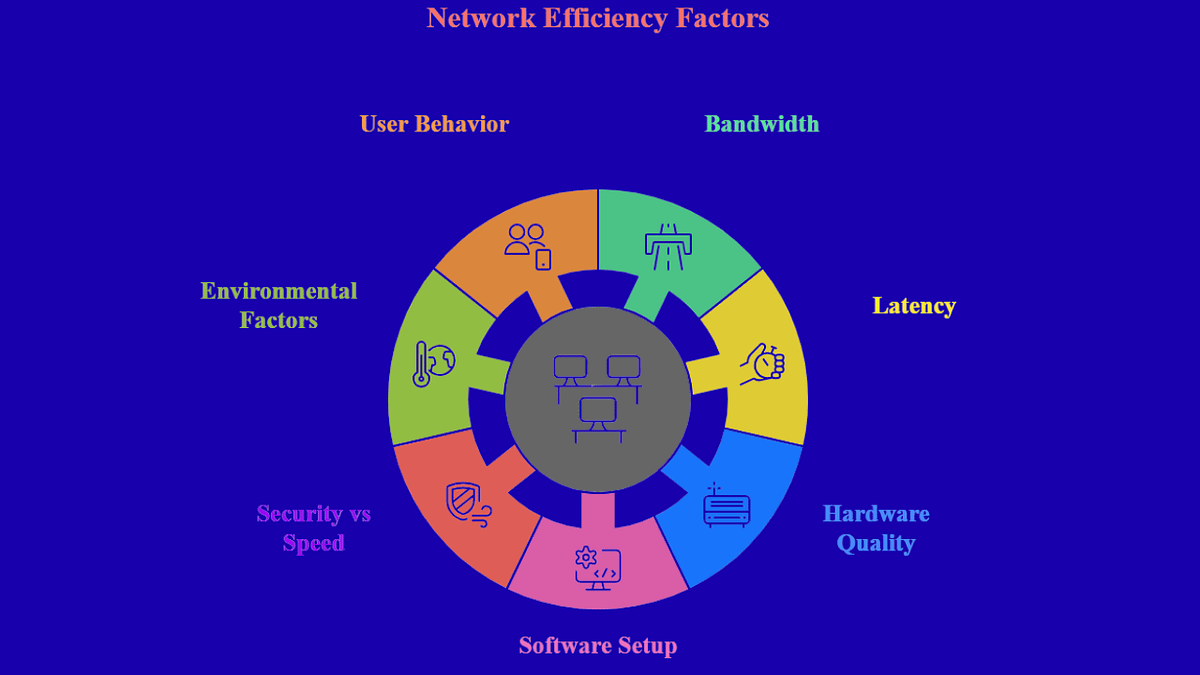
If your network feels slow or unreliable, it’s not always about a single issue—it’s usually a mix of things working together (or not). Let’s break down the seven key factors that directly affect how fast, smooth, and stable your network runs.
1. Bandwidth – Your Digital Highway
Bandwidth is the lifeline of your network. It’s the maximum data your network can handle at once—think of it like lanes on a highway. More lanes, more traffic flow. Without enough bandwidth, devices compete for space, causing slowdowns, buffering, and frustration, especially in high-traffic environments.
2. Latency – The Silent Delay
Latency is the time it takes for data to travel from one point to another. High latency can make your video calls lag, games freeze, or cloud tools stutter. Anything real-time, even a few milliseconds matter. Reducing latency is crucial for a smooth, snappy experience.
3. Hardware Quality – The Backbone
Your routers, switches, and access points are the backbone of your network. Using cheap or outdated hardware. Investing in high-performance gear makes a noticeable difference—it improves speed, reliability, and overall responsiveness.
4. Smart Software Setup
Even great hardware needs smart software. Well-optimized protocols, smart load balancing, and proper Quality of Service (QoS) settings can make your network prioritize important traffic—like Zoom calls over background downloads. It’s all about using your resources wisely.
5. Security vs Speed
Yes, security is a thing, however, excessive encryption or ineffective firewalls may slow down the process. It is important to find the balance between protection and performance. Install up-to-date security software which does not slow down your connection and use intelligent settings rather than default ones.
6. The Environment Counts
Wi-Fi doesn’t like walls, metal, or microwave ovens. Electromagnetic interference and physical obstructions can have a great impact on your signal. Ensure that your gadgets are properly positioned, raised and not exposed to any interference to maintain the connection firm and quick.
7. User Behavior & Traffic Spikes
Finally, the use of the network by people is important. Is there excessively high streaming 4K at a time? Do you have your team syncing files simultaneously on a daily basis? Knowing the busiest hours and usage pattern will enable you to schedule upgrades and load balancing in a more efficient way.
Bandwidth and Its Role in Network Performance
The bandwidth is a core part of the network performance, and the keystone of the data transmission capacity. It is the highest rate or the highest quantity of data that can be conveyed through a network connection within a specific period of time, which is often in bits per second (bps). The increased bandwidth also enables more data to be sent at the same time and this is vital in situations which demand high traffic and in ensuring smooth running.
Bandwidth is required to support a number of users and devices in a network. It can be explained in the context of a business environment where employees are able to use cloud-based applications, exchange substantial files and even conduct video conferences without experiencing a massive increase in their slowing down. Lack of bandwidth on the other hand can cause congestion and hence reduced data transfer rates as well as worse user experience. As such, it is important to make sure that the network is adequately band withed to satisfy its present and future needs in ensuring that it remains highly performing.
But just adding bandwidth may not be the panacea in all cases in network performance problems. One should take into consideration bandwidth management and allocation. To prioritize the critical applications and to make sure the bandwidth is effectively utilized, it is possible to implement such methods as traffic shaping, and quality of service (QoS) policies. As an illustration, QoS may give voice and video traffic priority over less time sensitive data, thus cutting the latency and enhancing the overall user experience.
Network Latency: What It Is and Why It Matters
The other important factor that influences network performance is the network latency. Latency is the duration required by a data packet to travel between the source and destination and vice versa and it is usually expressed in milliseconds (Ms). Latency may cause observable delays in communication and data transfer, causing a slow network experience that may become a productivity bottleneck and cause user dissatisfaction.
Network latency is caused by a number of factors such as distance between the source and destination, network hops, and processing time of the hops. As an example, the data that crosses long distances or other intermediary devices might have an increased latency with a greater number of relays. Furthermore, the network congestion and ineffective routing may worsen the problem of latency and additionally impair the performance.
Minimization of network latency is especially relevant to applications needing real time interaction, including video conferencing, online gaming and financial trading. Any single delay may also affect the user experience and efficacy of these applications to a great extent. Thus, network latency optimization can adopt strategies like reducing the number of hops, routing protocol that is faster, and implementing content delivery networks (CDNs) to move information to a place nearer to the end user.
In addition to that, latency should be monitored and measured at all times to determine and fix possible problems. Ping and traceroute may give information on the latency behavior and could be used to identify the cause of delays. Through active control and optimization of latency, institutions can have a faster and more efficient network to achieve the requirements of real-time applications and improve the overall performance.
The Impact of Network Hardware on Efficiency
Let’s be honest no matter how powerful your software is, if your network hardware is outdated, your performance is going to go down. Your routers, switches, access points, and network interface cards are the unsung heroes that keep everything flowing smoothly. When they are top-notch, your entire network feels faster, stronger, and more reliable.
1. Smart Routers & Switches – Smooth Traffic Flow
Think of routers and switches as traffic cops of your network. Good ones keep the data moving swiftly and know exactly where to send each packet. Enterprise-grade gear supports higher bandwidth, advanced load balancing, and QoS features—making sure critical tools like Zoom, Slack, or your POS system never skip a beat. But if you’re running on outdated hardware? Expect slowdowns, dropped connections, and frustration.
2. Modern Access Points Keep You Moving
A good Wi-Fi is not a luxury in the world we now live in, which is wireless-first. The newest entry points that support such technologies as Wi-Fi 6, MIMO, and beamforming are able to guarantee unproblematic connectivity even in the most crowded areas. It can be an office filled with remote employees or a warehouse with smart devices, the appropriate entry point ensures that everyone remains online without any snagging.
3. NICs: Small But Mighty
Network Interface Cards are often overlooked, but they play a vital role. High-performance NICs enable your computers and devices to support higher data rates, and even off-load processing to the CPU. The result? Faster and more efficient file transfers, multitasking throughout your network.
4. Just Buy It—Maintain It
Great hardware needs love, too. Regular firmware updates, hardware health checks, and knowing when it’s time to replace aging devices will save you from surprise breakdowns and downtime. Think of it as tuning up your car—you’ll thank yourself later.
5. The Bottom Line
When it comes to network efficiency, hardware isn’t just important—it’s foundational. By investing in quality equipment and keeping it maintained, you’re building a strong, high-performance infrastructure that supports every click, call, and connection your business depends on.
Software Optimization Techniques for Better Performance
High speed networks are not only about high speed hardware but also smart software. You can make your network fast, efficient, and reliable with the right tweaks and tools. These are some of the easy yet effective methods that can go a long way.
1. Optimize Network Protocols
Fine-tune TCP and UDP settings to boost data transfer speeds and reduce lag. Advanced options like Multipath TCP (MPTCP) use multiple paths to increase reliability and performance.
2. Balance the Load
Balance load distribution amongst the servers. This helps eliminate congestion, enhance performance and provide an additional fault tolerance. It operates at DNS, server or application levels.
3. Apply Quality of Service (QoS)
Apply QoS rules to give priority to important traffic such as video calls or VoIP over less important data. This minimizes jitter and ensures that high priority apps run without difficulties.
4. Monitor and Analyse Everything
Monitor performance using NPM and APM. Live data assist you in detecting problems in time before they arise, optimizing resources, and predicting requirements.
5. Combine and Conquer
When you bring these techniques together, your network runs faster, smarter, and more efficiently—creating a better experience for users and stronger support for your business.
The Role of Network Security in Performance
Network security is no longer just a protective layer — it’s a key part of how your network performs. While its job is to block threats and protect sensitive data, it can also impact how fast, responsive, and reliable your network feels. Striking the right balance between safety and speed is essential.
Encryption is one of the most essential tools in the network security toolkit. It keeps data safe as it moves through the network, ensuring no one can read or tamper with it. However, encryption takes processing power — the encrypting and decrypting process can slow things down, especially on large-scale networks. The solution is to use hardware acceleration, fine-tune encryption algorithms, and encrypt only the data that truly needs protection.
Firewalls and IDS/IPS systems act as your front-line defenders. They scan traffic, filter suspicious packets, and block unauthorized access. Scanning every piece of traffic can take time, but newer technologies like next-gen firewalls and application-layer filtering are designed to process more data at higher speeds without affecting security. Another effective approach is to spread the load among several devices to keep performance smooth.
Access control ensures that only the right individuals gain access. While multi-factor authentication and strict permissions add strong protection, they may introduce minor delays. Intelligent solutions such as single sign-on (SSO) and federated identity systems can minimize these delays, allowing users to access systems easily while keeping threats away.
Security should never become an obstacle to performance. When planned correctly, it enhances a fast, reliable network instead of slowing it down. Combining smart protection with performance-focused planning creates a system that is both strong and smooth.
Future Trends in Network Efficiency
With the changing digital world, networks that make it come into existence also change. In order to remain competitive, companies should be able to adjust to new trends that are transforming network efficiency.
The 5G is on the front line – it is fast with blazing speeds, reduced latency, and has the capacity to support more connected devices. It supports all the high-quality streaming as well as giant IoT systems.
Networks are becoming smarter with machine learning and AI. They assist in identifying the problems in real-time, optimization of traffic, and even auto-fixing which reduces downtime and improves the performance.
SDN (Software-Defined Networking) and NFV (Network Function Virtualization) introduce flexibility and control. They substitute hardened pieces of hardware with softened software, which simplifies the process of scaling and running networks.
Edge computing brings processing nearer to consumers, eliminating latency and lightening bandwidth loads- ideal with real-time applications such as autonomous technology and smart cities.
Lastly, more secure models of the security such as the zero-trust and blockchain protect without slackening the performance.
Conclusion
In an era where connectivity is paramount, network efficiency is the key to unlocking seamless communication, enhanced productivity, and overall business success. Understanding the top factors that impact network performance is essential for any organization looking to optimize its network infrastructure, track important metrics and stay competitive.
Long bandwidth and latency, quality of hardware, as well as optimization of software, all the factors are very crucial in determining how efficient a network is. Enough bandwidth is needed to guarantee that the network can support large numbers of data traffic, whereas low latency is essential in real-time Analytics. Fast hardware and properly adjusted software are the keys to efficient transmission of data and allocation of resources. It is also important to balance network security and performance to guarantee data protection and be responsive to it.
Looking ahead, future trends such as 5G, AI/ML, SDN/NFV, edge computing, and advanced security measures promise to revolutionize network efficiency. By staying informed and adopting these innovations, organizations can build robust and efficient networks that meet the demands of a rapidly evolving digital landscape.
To sum up, the idea of network performance improvement is not only the necessity to focus on the unique aspects separately, but the idea needs to be implemented in a comprehensive way, keeping in mind the interactions between different aspects.